Volt Amsterdam on the coalition agreement: where are the real choices?
This week, the Amsterdam City Council discussed the coalition agreement between PRO and D66. On behalf of Volt Amsterdam, Juliet Broersen spoke about what is good in the agreement, but also about the choices that, in our view, are still being postponed too much. You can read the full contribution below.
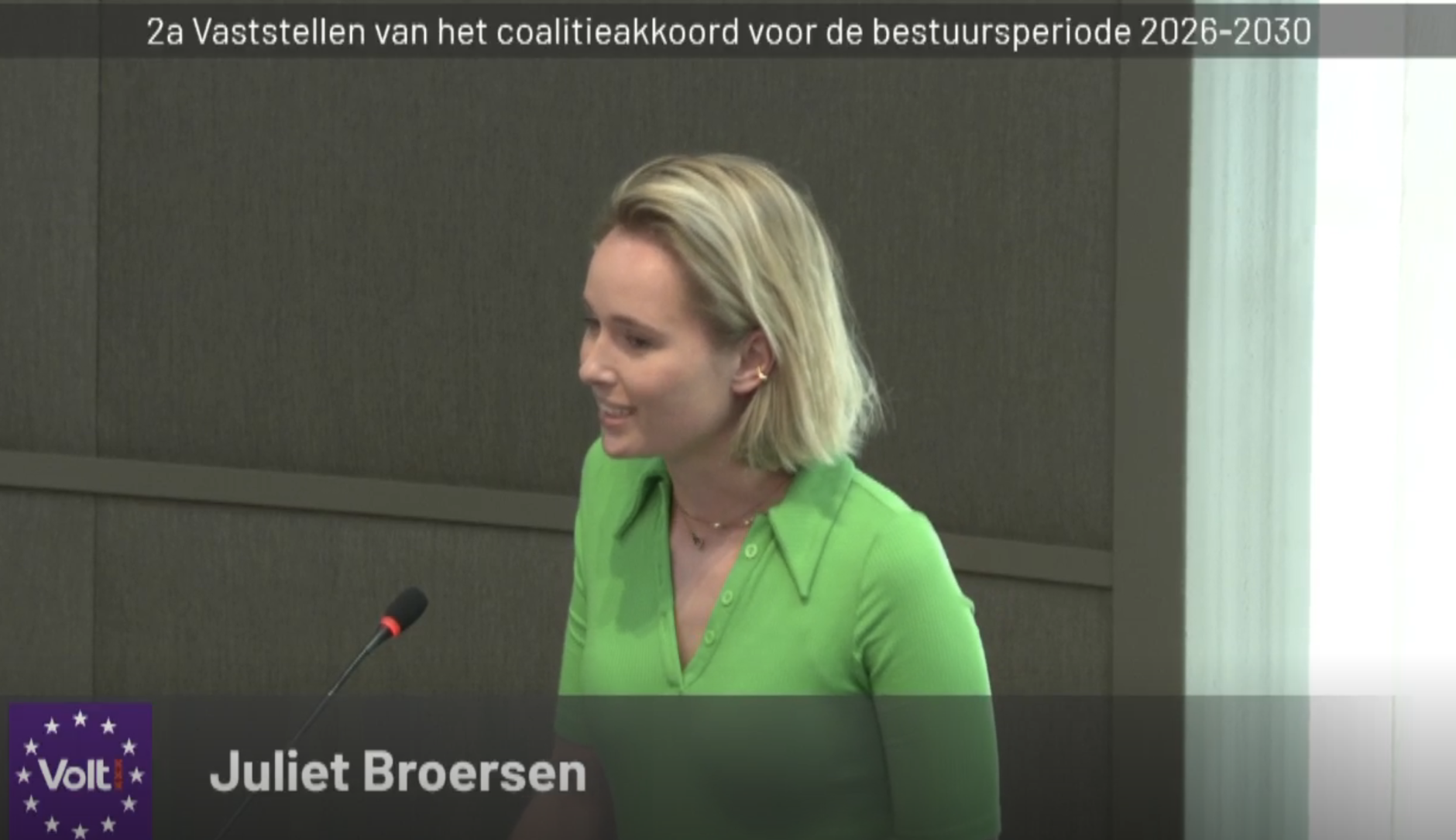
Chair, first of all, I would very much like to congratulate PRO and D66 on their coalition agreement. Amsterdam faces very major challenges, and I think it is good for everyone that we can get to work quickly. So I am also pleased that we are discussing a coalition agreement here today, and that it has indeed been presented to us at such a rapid pace.
We see ambition to take a critical look at the city’s own organisation, to strengthen the position and safety of women in the city, and to work towards a municipality that stands alongside its residents, instead of opposite them. And I am very pleased about that.
Over the past period, in the aftermath of the elections, I have also spoken with many people in the city who read a coalition agreement for the first time in their lives. And they said: “Well, actually, there is not much in it that you can be against.” And that is exactly the image these two parties seem to want to present. A very attractive picture has indeed been painted, but is it really the honest story? Are the hard blows and painful choices not simply being hidden away in subordinate clauses and clever wording? Or are the choices simply being postponed?
Building
Let me give an example. Building. What should be our number one priority now seems to be postponed through a Building Agenda. After all the debates and big words between these two parties about the housing crisis during the campaign, this agreement pushes the most important choices further down the road. Instead of presenting concrete plans and making clear choices, Amsterdam has to wait for a Building Agenda.
And of course, sitting down together around the table is a good thing. I am a strong supporter of that. But from these two parties, who fought so hard to have the final say on building and used such big words during the campaign, I really did expect to see choices. The fact that this does not happen in this agreement mainly gives me the impression that you simply did not fully manage to reach an agreement.
That is why we would very much like to know when the Building Agenda will be ready. In fact, I would very much like to see it by the end of this year. Because I do not want to wait too long for it. Amsterdam cannot afford another round of delay. We need to move forward.
And if building is apparently being postponed for a little longer, then please do something about the existing housing stock. And by that I am, of course, referring to an absolute no-brainer: permit-free house sharing. What a shame for the city that PRO won that negotiation.
For young people and starters, an affordable home in Amsterdam is no longer within reach. Young people are forced to live with their parents, without a contract, without registration, without rights. And unfortunately, this coalition has chosen not even to leave the door to house sharing slightly ajar, but to close it completely. Contrary to what Councillor Pels, and now Alderman Pels, suggested in the debate.
Geopolitics
From postponing to failing to look ahead. The past few years have shown how quickly geopolitical developments can affect the wallets of Amsterdammers. Higher energy bills, more expensive groceries, and extra pressure on households that are already struggling.
That is why I had hoped to read a bit more in this coalition agreement about how resilience will be put into practice. And, for example, about the future affordability crisis that several institutions are warning about. How do we make sure Amsterdam is prepared now, so that we are not caught off guard again? After all, the world does not seem likely to become much calmer over the next four years.
And no funding has been made available for this. The coalition agreement mentions energy independence, but in practice it acts too slowly. The budget for the insulation pact will only be available in 2028. Is that not far too late?
Public services
Chair, to move on to another point. Over the past four years, my group has worked hard to bring the human touch back into the way people are helped by the municipality. Many Amsterdammers have literally opened their doors to us and allowed us to see what happens behind them. And that showed us up close the impact of failing policy on public services.
Yet in our attempts to achieve systemic change on this point, we kept running into a closed door. Our request was too difficult, impossible, too soon, unwise, unnecessary — you name it.
That is why we are pleased that this coalition agreement appears to strike a different tone. But we do want to remind the Executive that this represents a major shift compared to the previous term, during which you were also in charge.
It requires opening the door to new forms of dissent, to new ideas, and daring to let go of the “computer says no” mentality. We will therefore be watching closely to make sure this actually happens.
In our view, this is also connected to the plan to cut 2,500 jobs. It is unclear what this number is based on and where these cuts will be felt most. The same still applies, for me, to the cuts to youth care and the Wmo.
Internationals
Finally, according to this coalition, this agreement is for everyone. What stands out is that internationals, whose votes both parties campaigned hard for, are not mentioned anywhere in this agreement. The challenges they shared during debates and public meetings do not return here.
And for us, this does not have to be a separate major programme. But if the municipality says it wants to be an ally to residents, then it must also pay attention to the Amsterdammers who, because of language, unfamiliarity with the system, or a smaller network, find it harder to find their way to the municipality.
And if you campaign so hard for that vote, then please make sure that voice is reflected in the agreement too.
All in all, many fine words, but still something of an agreement that kicks the can down the road.